
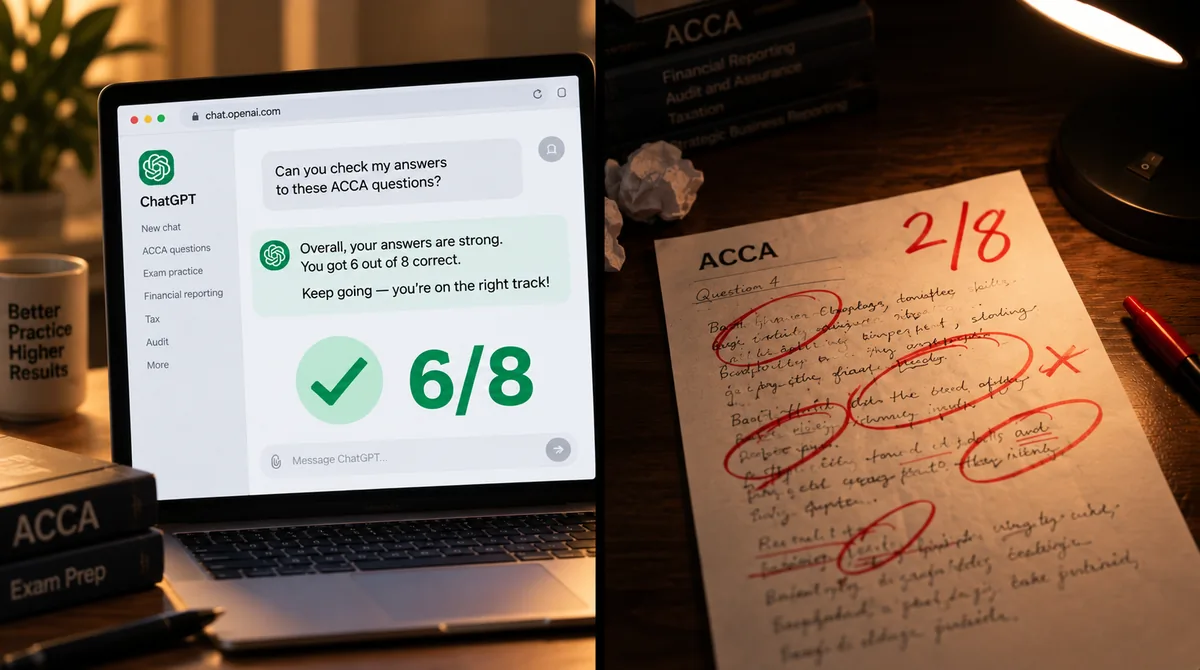
Write an answer. Paste it in. Ask how many marks it would get.
Enough candidates now do this that it has quietly become a standard part of revision for written papers — and it's not a silly idea. It's a sensible response to a real gap: you've written something, you have no way to judge it, and there's a tool sitting there that will give you an opinion in four seconds.
Why candidates started doing this
The gap it fills is genuine. On written papers you can't mark yourself — your own answer always reads well from the inside, because the logic connecting your sentences is already in your head. That's precisely the logic a marker doesn't have.
And ACCA doesn't close the gap either. My Exam Performance gives Applied Skills candidates a breakdown by syllabus area and per-question feedback. Strategic Professional — SBL, SBR, AFM, APM, AAA — returns a mark and nothing more.
So candidates improvised. One who topped a Strategic paper nationally described his method openly: write the answer, paste it in alongside the published examiner's answer, ask for a comparison. The replies under his post were full of people saying they'd started doing the same.
“I don't tell students to stop using it. I tell them to be precise about what they're asking it to do. Explaining a concept and judging a script are different jobs, and it's much better at the first one.”
What follows isn't an argument against using it. It's the specific list of things it can't do, so you know which part of its answer to trust.
1. It tends to agree with you
Language models are built to be helpful, and helpfulness pulls toward agreement. The way you frame a question shapes the answer you get back — which matters enormously when the question is "is this good enough?"
A marker has no opinion about what you were hoping for. That indifference is the entire value of external marking, and it's the one thing a conversation can't reproduce.
2. It doesn't have the mark allocation
Written marks aren't awarded for quality in the abstract. They're awarded against a specific allocation for that specific requirement — a set of creditable points a marker is looking for in that scenario.
Unless you paste that allocation in, the model doesn't have it. It's assessing your text as a piece of writing: is it coherent, is it relevant, is it well argued. Those are reasonable questions. None of them is the question the exam asks.
This is why the feedback so often sounds encouraging and general. "Well structured, could be more specific" is a fair comment on a piece of prose. It isn't an answer to "which of the eight available points did I make."
3. It can't tell marks apart
Not all marks on a written paper work the same way, and the differences change what you should do.
On AFM, method marks are available for showing your workings even when the final figure is wrong — which is why abandoning a calculation you're unsure about costs more than attempting it badly. On SBL, professional skills marks are awarded separately from technical content, for things like communication and commercial acumen. On AAA, a point about a risk earns differently from a point about the audit procedure that addresses it.
Generic feedback flattens all of that into "this section could be stronger." A marker doesn't flatten it, because the allocation tells them exactly which kind of mark each part was worth.
4. It doesn't weight the requirement verb
Evaluate, discuss, explain, recommend, calculate — these aren't stylistic variations. They determine what gets credited.
An answer full of sensible recommendations scores close to nothing against a requirement that said evaluate. It isn't wrong; it's answering a different question. This is one of the most common ways strong candidates lose marks, and it's almost invisible in general feedback, because as writing the recommendations are perfectly good.
5. The model answer comparison misleads
The most popular version of this technique is pasting your answer next to the published examiner's answer and asking for a comparison. It's the sharpest use of the tool, and it has a built-in distortion.
Published answers are written without a clock and more completely than a passing script needs to be. Compared against them, almost any real answer looks thin — including answers that would comfortably pass.
The prizewinner who described this method also said he never wrote answers as long as the examiner's. He knew to discount the comparison. Someone reading his method as a recipe won't necessarily know that, and will conclude their perfectly adequate answer is failing.
What it's genuinely good for
None of the above means close the tab. Used for the right jobs it's excellent, and considerably faster than the alternatives.
Worth using it for
- Explaining a concept you're stuck on. Ask for hedge accounting explained three different ways until one lands. A textbook gives you one explanation; this gives you as many as you need.
- Turning your notes into questions. Give it a topic and ask for scenario-based requirements to practise against. More useful than re-reading the same chapter.
- Checking your understanding of a published answer. When the examiner's reasoning is opaque, asking why a particular point was made is a fair question with a knowable answer.
- Rephrasing your own writing more professionally. Genuinely helpful, and closer to what the tool is built for than marking is.
- Generating variations of a scenario so you're not always practising on the same set of facts.
The line is simple enough. Understanding the material: excellent. Judging whether your script would pass: outside what it can do.
The fair objection: what if I give it the mark scheme?
This is the reasonable pushback, and it deserves a straight answer: yes, it does better. Paste in the published marking guidance along with your answer and the feedback improves noticeably. Anyone doing that is already ahead of most candidates.
Two things still limit it.
First, published guidance exists for past questions. It doesn't exist for the practice you write on your own topics, or for a question you've adapted, and those are a large share of anyone's revision.
Second, having the criteria isn't the same as applying them at a marker's strictness. Real marking is calibrated — markers are trained and moderated against each other so that a borderline point is treated the same way across thousands of scripts. A model reading the criteria fresh has no such calibration, and it stays inclined to give you the benefit of the doubt.
Where this leaves you. The instinct behind pasting your answer somewhere is exactly right — you cannot judge your own written work, and the exam won't tell you either. The tool just isn't built for that particular job.
What closes the gap is the same thing that always did: the mark allocation applied to what you actually wrote, by something that has no interest in agreeing with you.
See your answer marked against the allocation
Write one answer. Get it marked point by point — what earned a mark, what didn't, and why.
- Marked against the question's own mark allocation
- Method marks, professional skills marks and technical marks separated
- All written papers, Applied Skills and Strategic
Editorial sources
- ACCA — My Exam Performance, availability and scope
- ACCA — Examiner's reports and published answers
- ACCA — Exam pass rates, June 2026 session
- ACCA — Professional skills marks, Strategic Business Leader
About this content
Produced by the KRAMO editorial team for educational purposes. Descriptions of ACCA feedback and marking were checked against ACCA's published guidance at the time of writing. Observations about language-model behaviour describe general characteristics of these tools and are not claims about any particular product or version. Contributors were compensated for their time.