

You revised the topic. You recognised the question when it appeared. You wrote for the full time and left the exam thinking it had gone reasonably well.
Then the result page loads and there's a number in the forties.
That gap between how the paper felt and what it scored is one of the most common experiences in Strategic Professional, and it's disorienting precisely because effort wasn't the problem. You did the work. Something else decided the mark.
Knowing the material is not the same as scoring
Written papers are marked against a mark allocation — a set of specific, creditable points a marker is looking for, applied to the scenario in the question. Understanding a topic is what lets you find those points. It isn't what puts them on the page in a form that can be credited.
Two candidates with identical knowledge can finish fifteen marks apart. Not because one understood more, but because of what ended up written down.
“Candidates arrive at a resit assuming they need to know more. In most near-miss scripts the knowledge was already there. What was missing was the number of creditable points, or the link between the point and the scenario in front of them.”
Below are five factors that decide written marks. They overlap, and most scripts in the forties show more than one. The short check-in partway through this article helps identify which appears most strongly in how you work.
1. Too few distinct points for the marks available
A requirement worth eight marks is generally looking for something in the region of eight separate, creditable points. Not one idea explored in depth for eight marks — eight things.
This catches strong candidates in particular. Knowing a topic well encourages depth: you take one solid observation and develop it carefully across a paragraph. A marker credits that once and moves on looking for the next point, which isn't there.
One candidate who came back from 46 to 61 on a Strategic paper described exactly this. The fix wasn't more knowledge. It was writing more separate points.
2. Knowledge on the page, scenario left behind
Written papers award marks for applying something to the specific situation described. Not for reproducing what the standard says, however accurately.
The test is simple: could your answer be pasted into a different scenario without changing a word? If yes, it's a definition. Definitions demonstrate understanding and score close to nothing, because understanding wasn't the requirement.
"This could affect profitability" earns nothing. "This removes roughly two-thirds of turnover within four months" earns something. Same knowledge, different treatment.
3. No structure to fall into when the clock starts
There's a particular moment candidates describe: the question is on screen, the topic is familiar, and the cursor sits blinking in an empty box.
That isn't a knowledge gap. It's the absence of a default shape to fall into under pressure — and it costs minutes at the start of every answer, minutes that come out of the last question on the paper.
Candidates who pass consistently describe the same habit. One who passed a Strategic paper while working full time put it plainly: even when he wasn't sure what was going on, he followed a layout. The structure carried him to a pass that improvisation wouldn't have.
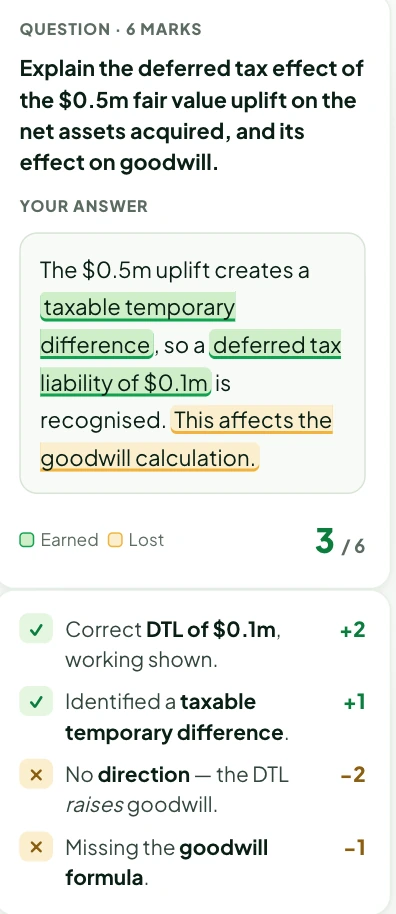
Write one answer. See which sentences earned marks and which didn't.
4. Marks distributed by comfort, not by allocation
Time on written papers tends to follow confidence. The question you feel strongest on absorbs more minutes than its marks justify, and whatever remains goes to the last one.
The arithmetic is unforgiving. An unwritten answer scores zero. An unfinished answer with its main points in place scores considerably more than a polished one that never got started — and the marks lost at the end are usually the easiest ones on the paper.
5. No way to check your own written work
This factor sits underneath the other four, and it's structural rather than personal.
With a calculation, you can mark yourself. Work it, compare it, know immediately whether it was right. With a written answer there's nothing to compare against — and your own answer always reads well from the inside, because the logic connecting each sentence is already in your head. That's precisely the logic a marker doesn't have.
ACCA's own feedback stops here too. My Exam Performance gives Applied Skills candidates a breakdown by syllabus area, timing and per-question feedback. Strategic Professional sits outside it — SBL, SBR, AFM, APM and AAA return a mark and nothing more.
Why studying longer often produces the same score
Without knowing which factor cost the marks, there's only one variable left to adjust: quantity. More hours, more revision, another pass through the exam kit.
Which produces the familiar sequence — 47, then 48. On discussion boards you'll find candidates on a third attempt at a Strategic paper, still in the mid-forties, working harder each time.
Worse, generic advice isn't neutral. One candidate failed at 43, took the common guidance before the resit — don't overthink it, trust your judgement — and came back with 35. Advice that helps a candidate writing too much will damage one already writing too little.
A clearer pattern is a more useful starting point
Falling short on a written paper after real preparation doesn't mean you weren't ready or didn't work hard enough. It means something specific happened between knowing the material and getting it onto the page in creditable form.
Identifying which of the five factors is most active won't fix a paper by itself. But it's a considerably better starting point than repeating the same preparation and hoping for a different number.
What an article can't do. Reading about these patterns tells you what to look for. It can't tell you which sentences in your answer earned marks and which didn't — that requires the mark allocation applied to what you actually wrote.
Model answers show a finished ideal, written without a clock. They don't show what's wrong with your version, and those are different pieces of information.
See how your own answer would be marked
Write one answer. Get it marked point by point, the way an examiner would.
- Marked against the question's mark allocation
- Every place a mark was lost, with the reason
- All written papers, Applied Skills and Strategic
Editorial sources
- ACCA — Exam pass rates, June 2026 session
- ACCA — My Exam Performance, availability and scope
- ACCA — Examiner's reports, Strategic Professional
- ACCA — Guidance on managing a narrow fail
About this content
This article was produced by the KRAMO editorial team for educational purposes. Statements about exam structure, feedback and pass rates were checked against ACCA's published guidance at the time of writing. Contributors were compensated for their time.
Pass rates are worldwide figures and do not indicate the probability of any individual result.